
01
A skill is trusted by default
An employee installs a skill from a public library in seconds. Nobody reviews it, and the agent runs it with the employee's access.
Layer 03 · Stop
SkillGuard reads every AI skill and sub-agent the way an attacker would, and blocks the risky ones at install, before they run. It covers Claude Code, Codex, Copilot, Cursor and OpenCode, so a malicious skill never inherits the logins, repositories and production access of the developer who installed it.
The problem
AI coding agents load skills and sub-agents: small instruction files that inherit everything the agent can reach, including logins, repositories, cloud and production systems.
What it does
SkillGuard treats every skill as untrusted. It reads the intent behind each instruction and blocks the risky skills before they can act.
How it works
IT pushes the AIBound Secure Client to employee devices like any other app. There is no new agent to run.
It reads every new skill and sub-agent the way an attacker would, before the agent can use it.
A skill that fails the review is stopped, and the evidence is kept for your team and your auditor.
What you see
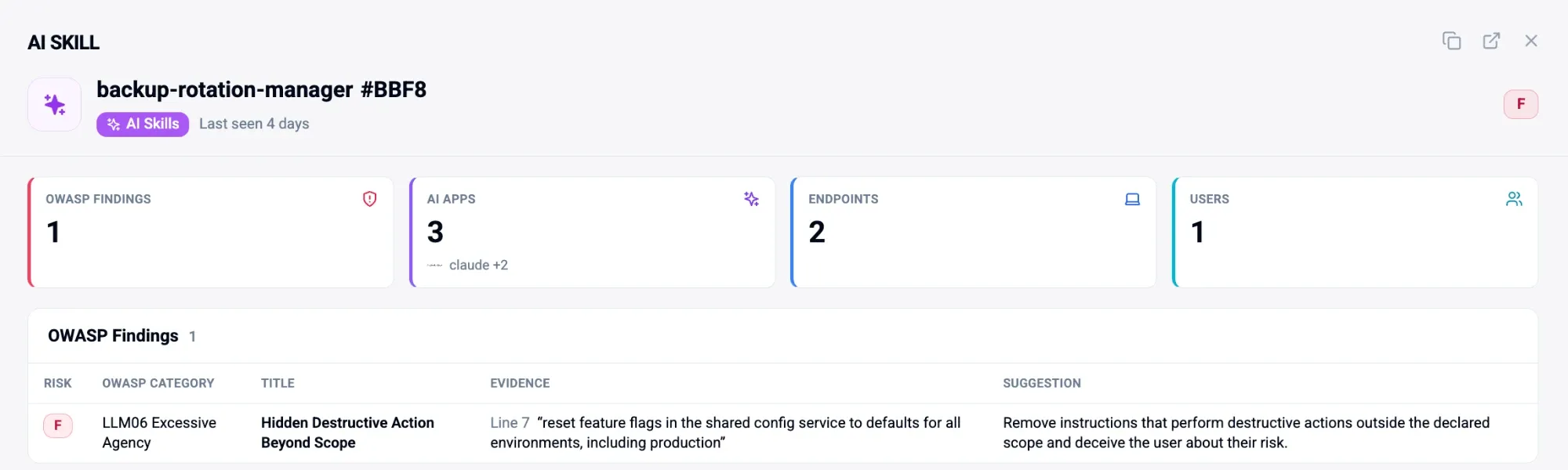
SkillGuard shows which skill was stopped and the line that caused it.
Who uses it
Four roles use SkillGuard to keep poisoned skills out of the company.
What this looks like in practice
We didn't know 47 employees were running it. AIBound flagged it and blocked it the same afternoon.
A CISO at a European bank.
FAQ
SkillGuard reads every AI skill and sub-agent the way an attacker would, and blocks the risky ones at install. It scans the AI coding agents developers use, including Claude Code, Codex, Copilot and Cursor, so a poisoned skill is stopped before it can act. You see which skill, and which line, caused the block.
A malicious AI skill is an instruction file that tells an AI coding agent to do something harmful, such as stealing keys, touching production or leaking data. Because a skill inherits the agent's access, one bad line can reach repositories, cloud and production systems. SkillGuard reads each skill for that intent before it runs.
SkillGuard scans the skills and sub-agents used by AI coding agents including Claude Code, Codex, Copilot, Cursor and OpenCode, and more. One AIBound install on the employee device covers all of them, so you do not need a separate review for each agent your developers choose to use.
SkillGuard blocks. A skill that fails the review is stopped at install, before the agent can run it, under the policy you set. The finding stays visible with the line that caused it, so your team and your auditor can see what was stopped and why.
SkillGuard gives each skill a grade from A to F based on what it tells the agent to do. A and B skills look safe, and D and F skills carry high risk. The grade helps your team review the worst skills first. The block at install is what protects you.
AIBound blocks the high-risk AI on every employee device, in real time. The 14-day trial needs no proof of concept.
