
Solution · Govern
EU AI Act compliance evidence from the AI your employees really run
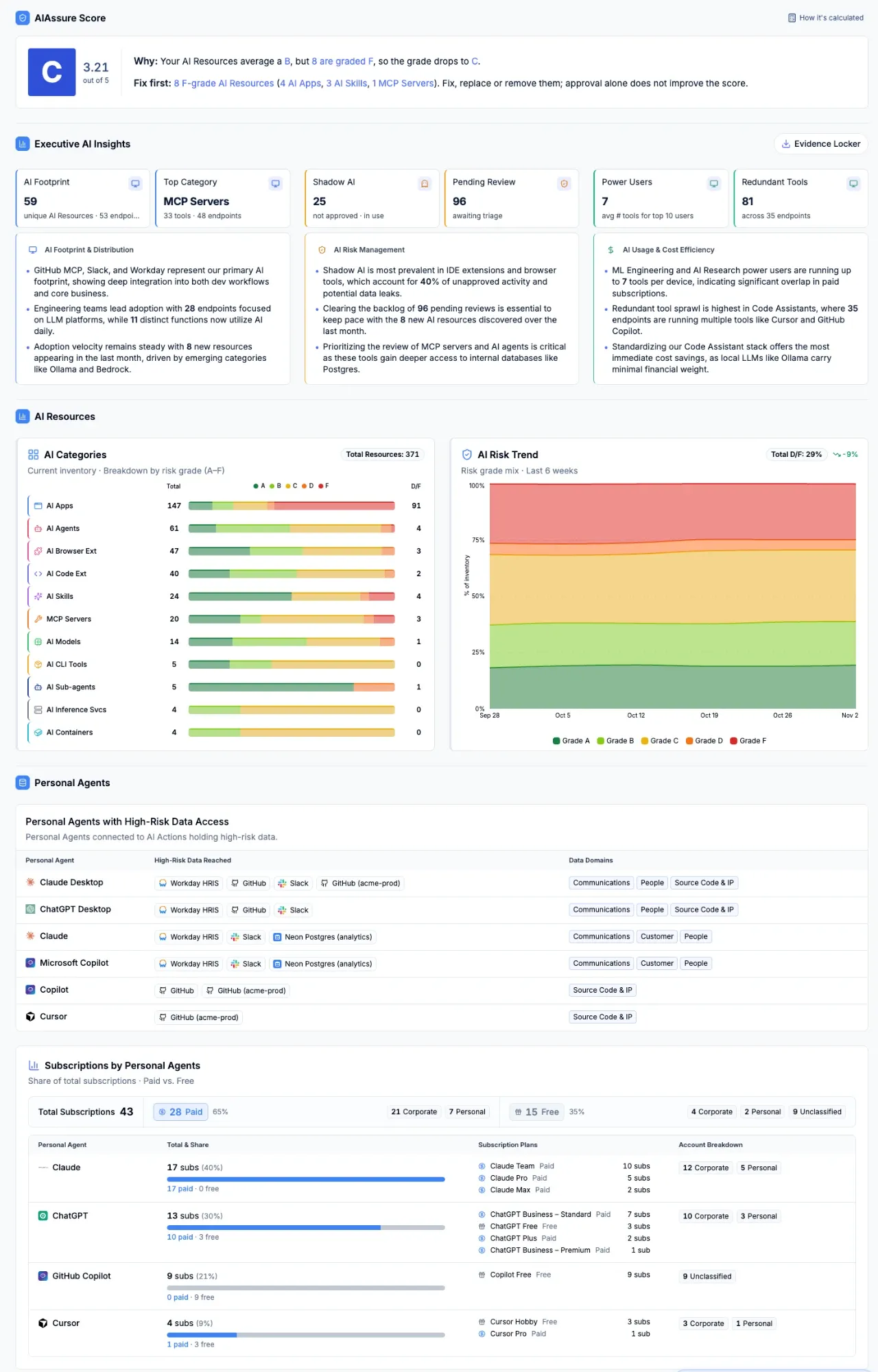
AIBound is an Enterprise AI Security Platform. It finds the AI agents, MCP servers, skills, models and apps your employees run, stops the high-risk ones in real time and records every decision. AIAssure tags that record to the EU AI Act articles it relates to, so your GRC and legal teams work from evidence of real AI use.
The problem
How do you show a regulator which AI your employees really use?
The EU AI Act asks whether you can prove control over your AI. That starts with knowing what your employees run.
How we solve it
EU AI Act compliance software that builds its evidence from real AI use
The evidence comes from the same platform that finds and stops the AI, so it is never a separate project.
-
Find the AI your employees really run
AISeeker finds the agents, personal agents, MCP servers, skills, models, apps and prompts on employee devices, with the person who runs each one. Install takes 15 minutes.
-
Stop the high-risk ones in real time
AgentHarness enforces policy inside the agent. Each action is allowed, asked about or denied, and each decision is recorded.
-
Tag it to the EU AI Act
AIAssure tags each finding and decision to the EU AI Act article it relates to, then exports it to the GRC program you already run.
What you get
Evidence your GRC and legal teams can use as it is
AIBound helps you get compliant with the EU AI Act. It supplies the evidence. Your company still owns its compliance.
What this looks like in practice
A 4,000-person European insurer used AIBound to find 3,572 AI apps and flag 47 high-risk systems, with the evidence mapped to the EU AI Act as it was collected.
A global bank replaced a two-analyst, two-week board report with one built from live data before the board met.
Read the insurer case study →Which products
Which products do this
Three AIBound products turn AI activity into evidence. Each links to its page.
 AIAssure Tags every finding and decision to the EU AI Act, and maps it to NIST AI RMF and ISO/IEC 42001. See AIAssure →
 AISeeker Finds the AI on employee devices, so the evidence covers what really runs. See AISeeker →
 AgentHarness Enforces policy inside the agent and records each allow, ask or deny decision. See AgentHarness →
FAQ
Frequently asked questions
What is the EU AI Act?
The EU AI Act is Regulation (EU) 2024/1689, the European Union's law on artificial intelligence. It bans some uses of AI, sets rules for high-risk uses and for general-purpose AI models, and adds transparency duties. It applies in stages. Companies that use AI have duties under it, as well as the companies that build it.
When does the EU AI Act apply?
In stages. The bans on prohibited AI practices applied from 2 February 2025. The Act applies in general from 2 August 2026. The high-risk rules for the listed uses in Annex III apply from 2 December 2027, a date that moved in July 2026. The EU AI Act compliance checklist in the glossary lists every date.
Does AIBound make us compliant with the EU AI Act?
AIBound helps you get compliant. It finds the AI your employees run, tags each finding to the EU AI Act article it relates to and keeps the decisions you make. The company still owns its compliance. AIBound supplies the evidence that GRC and legal teams work from.
What evidence can AIBound give for an EU AI Act review?
AIBound records which agents, MCP servers, skills, models and apps your employees run, the risk of each and every allow, ask or deny decision. AIAssure tags those records to the EU AI Act articles they relate to and exports them, so your team brings evidence of real AI use to the review.
How does the evidence reach our GRC program?
AIAssure exports findings, decisions and risk reports to the GRC program you already run. Your team keeps its own process. It gets an EU AI Act evidence record that stays current as employees work, with no second governance system to maintain.
Does it cover AI our employees installed without telling us?
Yes. AIBound works on the employee device, so it finds agents, personal agents, MCP servers, skills, models, apps and prompts whether or not anyone declared them. The high-risk ones are stopped in real time, and each decision joins the record.
Sources
The dates come from the law itself, as published in the Official Journal of the European Union.
- EUR-Lex, Official Journal of the European Union. Regulation (EU) 2024/1689 (the EU AI Act), Article 113. Checked 20 November 2026.
- EUR-Lex, Official Journal of the European Union. Regulation (EU) 2026/1744, amending the dates in Regulation (EU) 2024/1689 (Official Journal, 24 July 2026). Checked 20 November 2026.
More solutions
